A great deal of the work I do is supported by Claude: parsing packet captures, reverse-engineering binaries, working through forensic artifacts, and building open-source tooling — some of it designed to run on local models so self-funded students and small teams aren’t priced out of serious capability.
Part I
The Case for CTFs
A lot of that work traces back to CTFs, the competitions where many of us cut our teeth before anyone is willing to bring us on for a real job. That accessibility piece matters to me more than almost anything else. It’s the reason I do this work at all.
CTFs are wildly underrated by the wave of emerging cybersecurity specialists flooding the platforms; you can tell who’s actually battle-tested by offering a simple challenge and watching the cert-only résumés fall apart.
This is how I use CTFs — and how that foundation helped me secure a spot in Anthropic’s CVP program.
The CTF work matters for a second reason, one that goes beyond any single application. Every solution we document is full methodology, not just the flag; it becomes structured data — a real problem worked from confusion to resolution, detailed enough that a model can learn from the reasoning, not just the answer. That’s the raw material small, locally-run models need to get better at defensive reasoning without requiring access to production incident data most teams will never open-source.
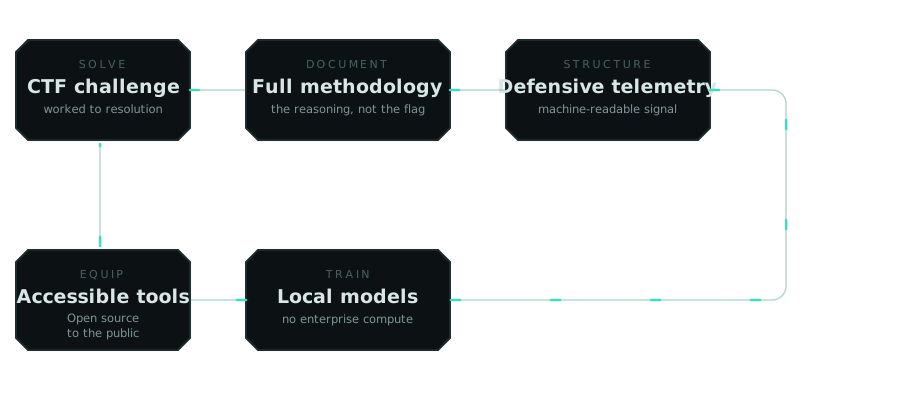
Contestants and researchers generate the data that trains the defensive models — and those models become the tooling built for the next contestants.
When students publish complete CTF methodology, we’re not just building a portfolio — we’re generating exactly the kind of training signal that makes local, defensive-focused tooling viable for people who can’t afford enterprise-scale compute. Contestants generate the data that trains tools built for other contestants; that loop is part of why this work feels worth doing beyond the résumé line.
Part II
The Trust Boundary
From the perspective of a student researcher, this is where the real tension shows up: vulnerability analysis, exploit development, and offensive tooling for CTFs fall squarely into what Anthropic classifies as high-risk dual-use. At the level of a raw request, a defender studying an exploit and an attacker weaponizing it can look identical, so Claude’s Opus and Sonnet models block that category by default. It’s a reasonable safeguard, but it’s also exactly the kind of friction legitimate practitioners run into constantly.
And yet, building accessible security systems still requires the ability to analyze telemetry patterns, binaries, and behavioral traces through API-driven workflows — the very processes that support the data collection pipelines these models rely on. That’s the contradiction we keep running into: the work that makes defensive tooling accessible is the same work safety systems are designed to resist. So the question becomes whether Anthropic’s stance is simply a coincidence of policy, or another deliberate attempt to navigate a genuinely hard problem in making powerful tools safe and widely usable.
Anthropic’s answer to this entire problem is the Cyber Verification Program (CVP) — a free, application-based review that allows verified defensive practitioners to keep working without running into those default blocks. I applied, and my application was approved. The application and eligibility details are linked below if you want to go straight to the source.
What the approval does and does not cover matters — precision here isn’t optional. CVP lifts default blocks on dual-use activities: basic pentesting, red teaming, bug bounty, and the exploit-analysis work that naturally comes with them. It does not unlock prohibited-use activity — command-and-control infrastructure, mass data exfiltration, ransomware development — and it never will. Those stay blocked regardless of status, by design.
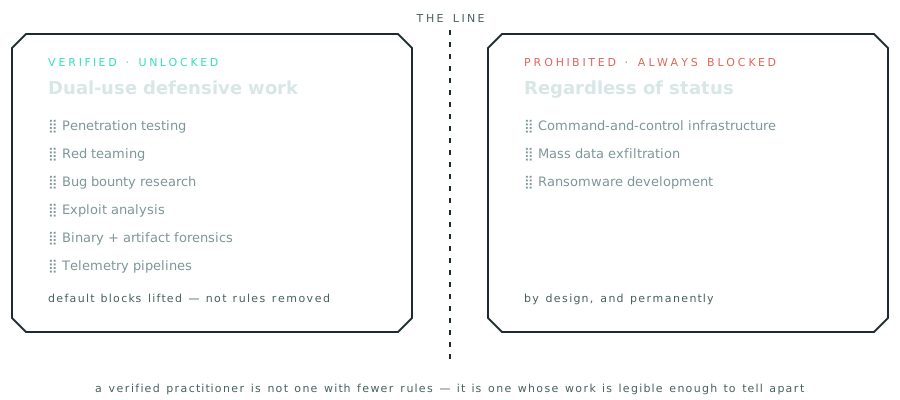
A verified practitioner isn’t a practitioner with fewer rules; it’s one whose legitimate work has been documented clearly enough that the system can reliably tell the difference.
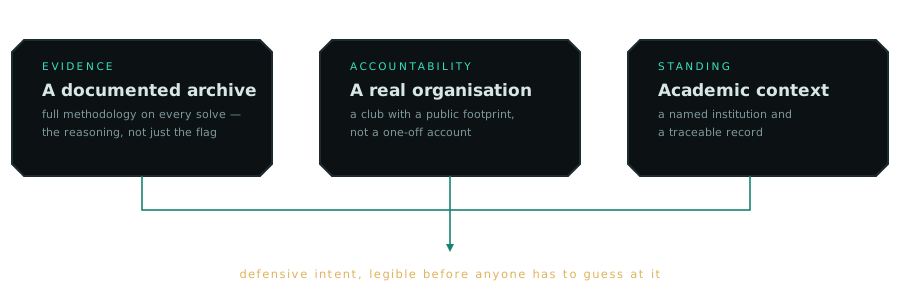
What I believe actually strengthened my application — based on going through it, not on any inside knowledge — is that a documented, consistent pattern of legitimate defensive work counts for more than any single credential. In my case, that meant our CTF archive with full methodology on every solve, our academic standing, and the fact that ECHOClub is a real, accountable organization with a public footprint rather than a one-off account. If your defensive intent is legible on paper before a human ever has to guess at it, that’s the strongest thing you can bring.
The approval also unlocks something subtle but incredibly important: the ability to process CTF data without constant safety interruptions, which means I can take full methodology write-ups, packet captures, binaries, and forensic artifacts and convert them into machine-readable defensive telemetry. That structured output becomes training material that small, locally-run models can repurpose — improving defensive reasoning without needing access to enterprise-grade incident data. In other words, CVP doesn’t just remove friction; it directly enables the creation of high-quality defensive signals that benefit the entire local-model ecosystem.
But that capability comes with responsibility. CVP access isn’t a badge — it’s a trust boundary. The data you process, the workflows you build, and the outputs you generate need to stay secured within your network and your research environment. Treat the privilege like you would any sensitive defensive infrastructure: controlled access, clear audit trails, and a culture of accountability. The program works because practitioners respect the line between defensive analysis and prohibited use, and because we protect the material we handle as if it were production-grade.
If you’re a security student, researcher, or practitioner who’s hit these blocks doing legitimate work, it’s worth applying. And if you’re building tooling meant to run on local models so that cost is never the barrier to entry, CVP is designed for exactly that kind of accessible, education-first security work. It protects the people who are trying to make the field better, not harder to enter.
In the end, this is the kind of soul.md Anthropic aims to deliver with
programs like CVP — a philosophy of safety that doesn’t shut out legitimate
researchers, a commitment to accessibility that doesn’t compromise security, and a
belief that empowering the right people strengthens the entire ecosystem.
References
- Real-time cyber safeguards on Claude Opus and Sonnet Anthropic · official support documentation support.claude.com/en/articles/14604842
- Cyber Verification Program — interest & application Anthropic · official form claude.com/form/platform-cvp-interest
- Cyber use-case submission Anthropic · official form claude.com/form/cyber-use-case
- False-positive report & CVP rejection appeal Anthropic · official form claude.com/form/cyber-block-false-positive-report-cvp-rejection-appeal
All links verified reachable at the time of publication, August 2026.
Further reading
- Anthropic Fellows Program 2026 Anthropic Alignment alignment.anthropic.com/2025/anthropic-fellows-program-2026
- CVP: the Cyber Verification Program and defensive security Third-party practitioner write-up — not an official source bregg.com/blog/cvp-cyber-verification-program-defensive-security
Get in touch
Requests, collaborations, or concerns
If something here is wrong, or you want to work on it with us, say so. Corrections are welcome and get published.